Week 2: Slowness. Slow Enough to Notice, Normal Enough to Play
Week 2 of the petanque training cycle sounds simple. Slow the arm. Throw a few boules at roughly half speed. Notice what changes. Then bring the throw back to normal speed.
That is the whole idea, but it is easy to misunderstand.
Slow Arm can sometimes help in play, especially when pointing. A softer, slower arm can stop the boule racing away and give you more control. But that is not the main purpose here.
In this article, slowness is being used as a magnifying glass. For a few boules, you slow the throw so the grip, wrist, release, finish and balance become easier to feel. Then you bring the throw back to your normal rhythm.
Those details are usually there, but they pass too quickly to notice. Most of the time the result is the loudest thing. Short. Long. Hit. Miss. You see where the boule finished, and the mind jumps straight to judgement.
Week 2 asks for something quieter. For a few throws, turn the volume up on the movement itself.
Then bring the throw back to normal speed.
That is the promise of the habit: slow enough to notice, normal enough to play.
Speed is useful
Speed is not the enemy here.
In petanque, you still need rhythm. The arm still needs to swing freely. If you slow the arm so much that the shot becomes stiff, you have gone too far. A good throw still has to leave the hand cleanly, travel on the line you chose, and arrive with purpose.
The problem is not speed. The problem is rushing.
When the throw rushes, the result arrives before you have really felt the throw. You know the visible outcome. The boule was short, long, close, wide, or hit. But you may not know what actually happened in the hand.
That is why players often want to throw the next boule immediately after a miss. The result has annoyed them, and the body wants another chance. But they have not kept much useful information from the throw they just made. They are trying to correct a result, not understand a movement.
Slow Arm gives some of that time back.
It lets you ask one small question while the throw is still fresh enough to feel. Did the wrist stay soft? Did the release happen cleanly? Did the arm finish through the shot? Did the head stay quiet?
The aim is not to make the slow boule perfect. The aim is to make what happened in the throw noticeable.
Pick one thing
The temptation is to fix the whole throw.
Most players do it. One boule goes wrong, and suddenly they are thinking about the grip, the wrist, the arm, the legs, the line, the landing spot, the surface, the score, and everything else at once.
That is not attention. That is noise.
Slow Arm works better if you resist that urge. Pick one thing.
If the boule keeps dropping short, maybe the question is the finish. If it comes out flat, maybe the question is the wrist. If the throw feels snatched, maybe the question is the release. If the line wanders, maybe the question is where the hand finishes.
For the slow boules, stay with that one question. What is the grip doing? What is the wrist doing? What is the release doing? Where does the arm finish?
If another thought appears, let it wait. It might be useful later, but not for this set. The strength of the drill is that it narrows attention before the conscious mind gets too busy.
And when you go back to normal speed, do not carry six thoughts with you. Carry one observation.
That is the discipline of the drill.
Do not judge the slow boules
This is the part that changes the feel of the practice.
The six slow boules are not a test of whether you are good. They are not there so you can decide whether your technique is fixed. They are not there so you can give yourself another lecture.
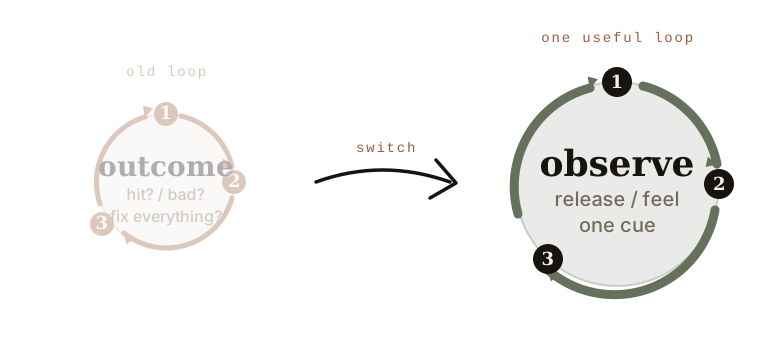
They are there so you can observe before the outcome starts talking.
Instead of saying, “that was terrible,” describe what happened: the release was late, the wrist tightened, the finish stopped, the balance moved.
That kind of sentence gives you something you can use. A judgement closes the door. An observation opens the next throw.
If the release was late, the next slow boule has a question. If the finish stopped, the next slow boule has a question. If the wrist tightened, the next slow boule has a question.
This is the lesson I take from W. Timothy Gallwey’s The Inner Game of Tennis: the body has a better chance to learn when you describe what is true before you start interfering with it.
That does not mean errors do not matter. It means you are trying to see them clearly enough to learn from them.
Turn feel into information
The first benefit of Slowness is not a more polished action. It is clearer information.
At normal speed, the body has a lot to tell you, but the message can be too quick and too mixed up to notice clearly. The fingers, the wrist, the release and the finish all happen inside a small piece of time. If attention jumps forward to the result, that information disappears.
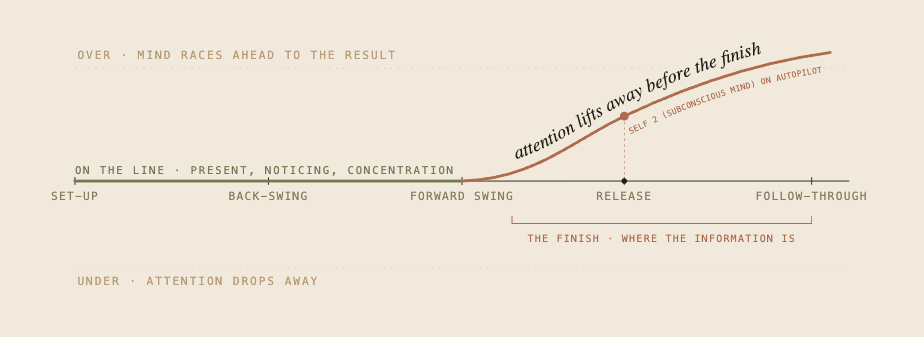
When you slow the arm, you give yourself a chance to feel your movement sense. The technical word is proprioception: the body’s sense of position and movement. Han and colleagues’ open review of proprioception in sport and exercise is useful background here, but on the piste the practical version is simple: notice what the hand, wrist and arm are doing before the result steals all the attention.
Ask something you can actually feel. Where is the hand? How fast is the arm travelling? What happens at the release? Does the finish continue through the shot, or stop early?
This matters because you are not guessing. You are feeling one clear part of the throw and then testing it. The slow boule turns the body signal up just enough to notice it.
From a coaching perspective, keep the question small enough for the player to feel. Instead of saying, “your technique is wrong,” ask something specific. Did the wrist stay soft? Did the fingers let go cleanly? Did the arm finish toward the shot?
Good coaching language matters here. Nick Winkelman’s The Language of Coaching is useful because it keeps the coach honest: can the player carry the cue into the next throw? A cue that needs a paragraph is usually too large. A cue that can be felt straight away has a chance.
Keep the shot in the drill
There is one mistake to avoid with Slow Arm.
Do not remove the shot from the drill. If there is no landing spot, no line, no target boule, and no surface to read, you are only rehearsing an arm movement. That might look tidy, but it will not always help when you step into the circle and have to play a real boule.
In coaching language, those details are constraints. The landing spot, the line, the terrain and the target give the throw a job. Slow Arm works best when you simplify the movement without stripping away the game.
So keep one piece of the game inside the drill. If you are pointing, keep the landing spot. If you are shooting, keep the target boule. If you are shaping the shot, keep the arc. If the piste has a slope or a rough patch, let that stay in the problem.
The result should not take over, but the boule still needs a job.
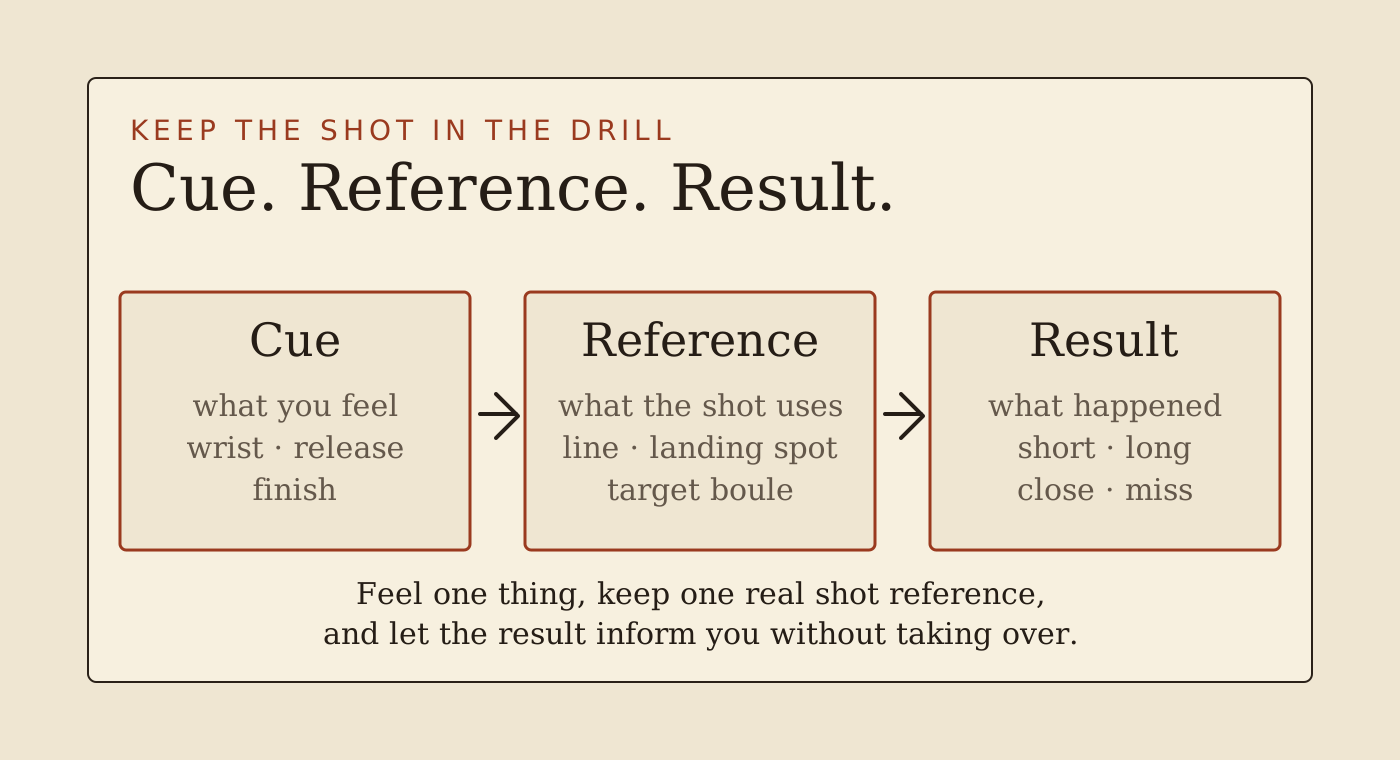
The order matters: cue, reference, result.
The cue is what you feel in the movement: the soft wrist, the clean release, the finish through the shot. The reference is what the shot is built around: the landing spot, the line, the arc, or the target boule. The result is where the boule finishes.
Feel the cue. Keep the reference. Let the result inform you without taking over.
A coach might call this representative practice. The plain version is simpler. Keep enough of the real sights, surfaces and decisions in the drill so the learning can travel back into play.
Keep the shot in the drill.
Make it just hard enough
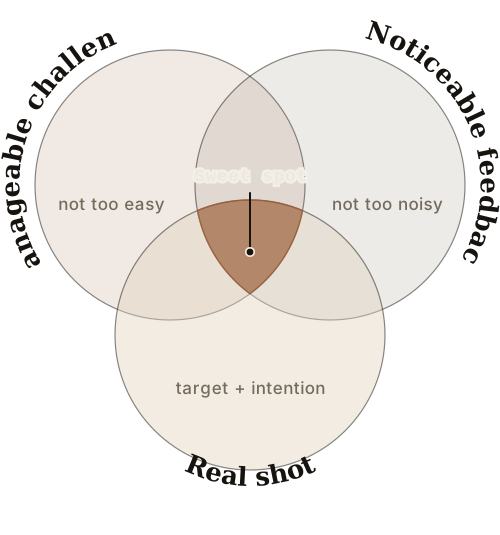
Use that as your check while you practise.
If every boule feels easy, the drill is not teaching much. Tighten the landing zone, move the target, or choose a less comfortable line.
If every boule feels random, simplify it. Shorten the distance, widen the landing zone, or remove one complication.
The aim is not for every boule to count. The aim is for every boule to give you something noticeable. When you miss, you should still be able to see a clue: late release, wrong line, different weight, or the surface changing the boule.
That is close to the player version of the Challenge Point Framework described by Mark Guadagnoli and Timothy Lee. Practice works best when the task is difficult enough to create learning, but not so difficult that the feedback becomes noise.
To try that idea, this six-boule pétanque training drill changes the distance while you keep one intention.
Then bring your normal rhythm back
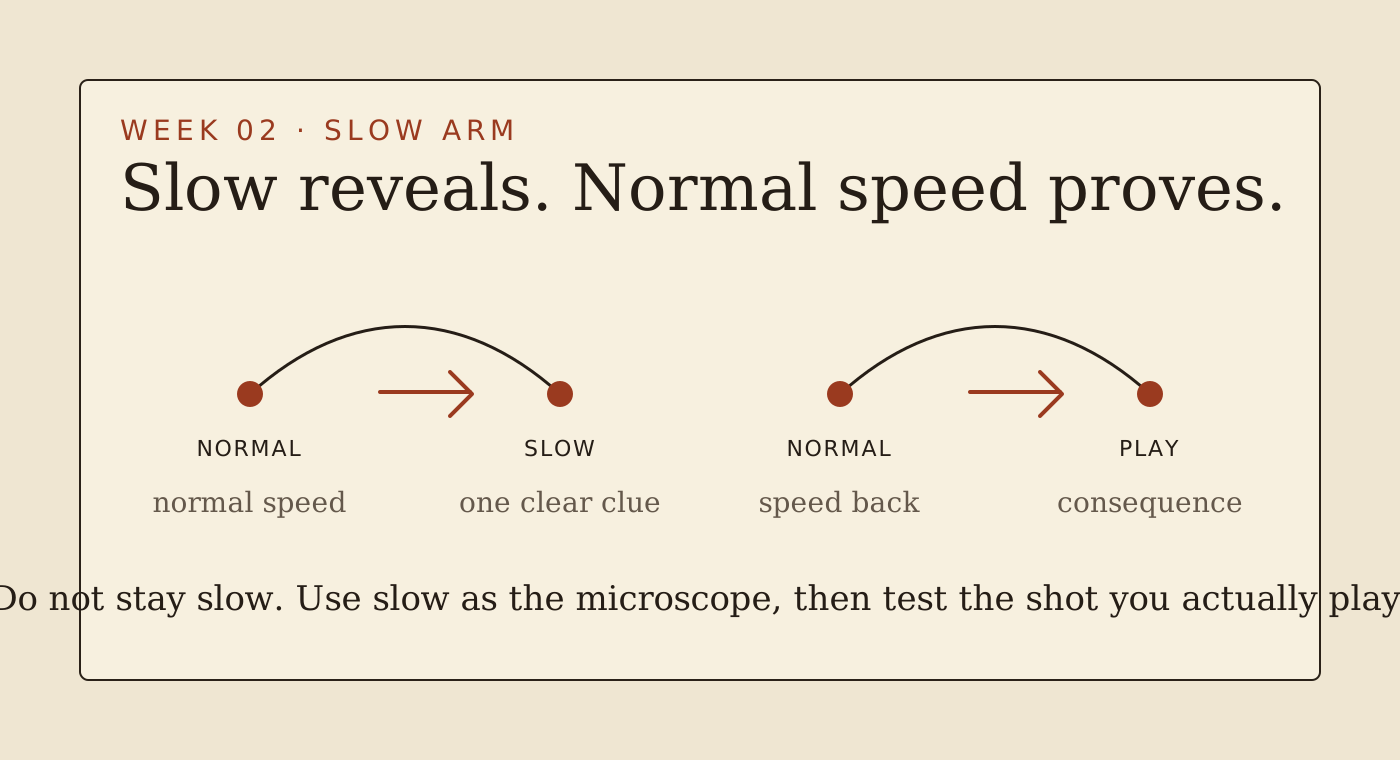
The slow throw is a check, not a new way to play.
Once you have noticed one thing, put the shot back into your normal rhythm. This is where the habit matters. At half speed, a release can feel clean because the body has more time. When the rhythm returns, the timing may change, the release may tighten, or the balance may move.
So do not finish the drill with the slow boule. Throw again at normal rhythm and ask one simple question: did the cue travel with me?
If it did, keep it. If it disappeared, that is useful too. Make the cue smaller, shorten the distance, or use one bridge throw before going fully back to normal.
Slow reveals the clue. Normal rhythm tells you whether it is ready for play.
Carry a cue, not a lecture
Pressure is where simple matters.
In a real point, you cannot carry a technical lecture into the circle. There is no room for five corrections and a busy conscious mind trying to manage every part of the throw.
The practice set should leave you with one cue that feels trustworthy. It might be a word, a picture, or a short phrase: soft wrist, finish the movement, let it leave, shape the shot, see the spot, send the boule. The point is that it can travel from practice into play.
For me, shaping the shot is that kind of cue. In the hoop drill, I picture the boule travelling through the arc. When I shoot, I can carry the same picture toward the target boule. It does not make every shot perfect, and it should not pretend to. It just gives me a better chance more often.
That is a useful standard for any cue.
Can you see it, feel it or say it quickly before the throw? Can you use it without freezing? Can you still look at the target and commit to the shot?
That is the standard. Not perfect. More often.
What to write down
For Week 2, keep the record simple.
Throw six slow boules, followed by six normal boules. The slow six are for noticing. The normal six are for checking whether the cue can travel back into your real throw.
Then write one useful sentence before the memory fades.
Not a full technical review. Not a score sheet. Just one clear note:
What did the slow throws reveal, and did it still appear when normal rhythm returned?
The journal helps because what feels clear at the end of practice can be gone by the next morning. One sentence keeps the cue available for the next session.
You can still log the three best throws, but do not only choose the three closest boules. Choose the throws worth repeating: the clean release, the better finish, the boule where the rhythm came back without losing the cue.
Three questions are enough: where did the throw start to pick up speed again? What changed when I slowed the arm? Which cue survived the return to normal rhythm?
Those notes do not make the throw more complicated. They stop the lesson disappearing.
Keep the conversation going
Practice is easier to keep going when you are not doing it on your own.
A good friend of mine, Kevin O’Rourke, runs the PetanqueCoach YouTube channel, which has now passed 4 million views. He has also started the Petanque Performance Academy on Skool.
The academy already has around eighty members, with proper petanque discussions happening every week. If this article has made you think about your own throw, it is a good place to ask questions, compare notes, and hear how other players are working on the same kind of habits.
The Week 1 video session on Awareness is available to all members for free. You can also reach me there directly if you want advice on the journal, this drill, or your own practice.
Join here: Petanque Performance Academy
Do not forget the drills newsletter too. If you want something practical to take to the piste, sign up for the free Late Release drill. It is a useful companion to this Slow Arm work because it helps you pay attention to the release, the finish, and what the boule does after it leaves the hand.
Get the free drill here: Late Release drill
If you want the structure behind these sessions, the Petanque Performance Journal is the companion I built for that job. It gives you the six week practice cycle, the habit pages, and a simple way to record what you noticed before it disappears.
Order it here: Petanque Performance Journal
Discussion
Loading the discussion…
No comments yet. You can start the conversation.
Comments are temporarily unavailable.
Your comment will appear straight away. Spam or abusive comments may be removed.