Week 1: A deeper dive into Awareness
Week 1 of the petanque training cycle asks for one thing, and it is harder than it sounds. Pay attention. Don’t correct anything yet. Just watch your own throw and write down what is actually true. It is where the whole journal begins, and it is worth a closer look.
For years of playing petanque I never really watched myself throw. My eyes were on the boule, the target, the result. The gesture was happening in the dark, and the body was making decisions I never saw. Week 1 is the antidote to that, and it is why awareness comes before anything else in the journal. In your own petanque practice you spot what happens when you throw, and you name it before the memory disappears. The journal is simply somewhere to put what you notice.
It matters that you don’t try to fix anything. The moment you start correcting, you stop seeing. And you cannot change what you have never watched. Seeing comes first.
Awareness needs concentration
Here is the part that sits just underneath awareness, and it isn’t always obvious. You can only notice what you have the concentration to stay present for. Let your attention drift before the boule leaves your hand, and the moment that matters most, the release, happens while your mind is somewhere else.
And the body can’t learn what it can’t feel. If you never give yourself the chance to notice the throw, there is nothing for it to learn from. This is the heart of Timothy Gallwey’s The Inner Game of Tennis: awareness, not instruction, is what teaches the body.
“The greatest lapses in concentration come when we allow our minds to project what is about to happen or to dwell on what has already happened.”
W. Timothy Gallwey · The Inner Game of Tennis
The same attention meditation trains
If this sounds like meditation, that is because it is the same skill. Slow the breath and you steady the heart. Practise mindfulness and the senses sharpen, you notice touch, feel, and what is around you. It is the same attention that lets you notice your throw.
Petanque is eighty per cent mental, if not more. Calmer and more relaxed, you are more present, and the mind is far less likely to drift and fix on the outcome. Meditation has helped me stay present in the big moments, the tight games where a boule has to count. I trust my routine, not the outcome. In those moments there is no doubting voice left to get in the way, and the part of me that already knows what I am trying to do is left to get on with it.
Where attention goes in one throw
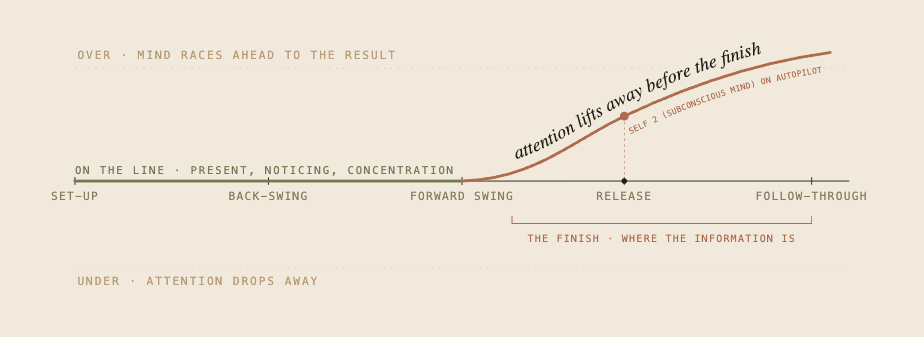
Picture a single throw as a line, left to right. Early on, attention rides with the gesture, present and noticing. But it tends to lift away before the finish, the release and the follow-through, racing ahead to where the boule will land. That finish is exactly where the information is.
If the conscious mind has already raced ahead, the throw finishes on autopilot, and you never feel what the wrist and arm actually did. You can’t learn from a finish you didn’t notice. Noticing the finish is what reveals the subtle things, and those become the foundation for any change you make later.
And across a whole game
The same line stretches across a whole game, and it can pull you in two directions. Get a comfortable lead and nothing tests you, so attention drifts down, under-stimulated, and you stop watching throws that still count. Let the score tighten and the opposite happens, you tense up, over-try, and the mind races ahead to the result. Awareness is the habit that keeps you on the line in both.
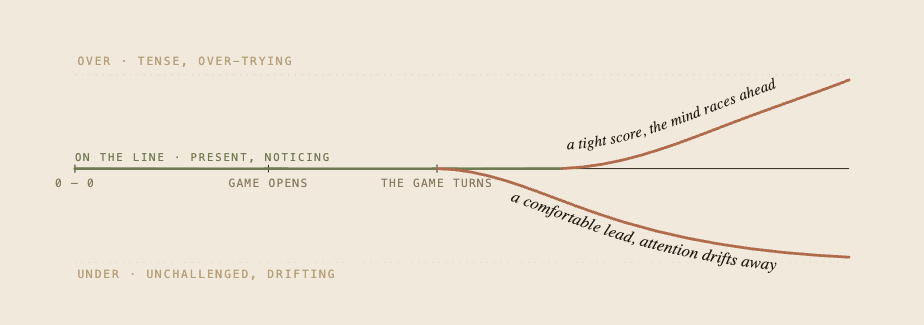
This is close to what Mihaly Csikszentmihalyi describes in Flow: The Psychology of Optimal Experience: full absorption in a clear, demanding activity where feedback keeps arriving and the challenge sits close to the player’s skill. In petanque terms, the feedback is shot by shot: see the line, feel the release, read the landing. Borrowing Gallwey’s language, quiet Self 1, the conscious, overthinking mind, so Self 2, the trained doer, can get on with what the body already knows.
What changes first is never the throw. It is what you start to notice.
That is the whole of Week 1: Awareness. Notice, don’t fix. The journal itself is a training companion, somewhere to track these changes session by session as they happen, rather than the place that explains them in full. Articles like this one are where I go deeper, and I’ll be releasing free detailed pieces on each weekly theme, along with drills to support them.
In time I intend to bring it all together in a fuller petanque book covering this in far more detail. For now, the Petanque Performance Journal is the companion that keeps you honest week to week.
And if you would like a detailed drill to train this on the piste, sign up for the free Late Release drill. I think you’ll like it.
Discussion
Loading the discussion…
No comments yet. You can start the conversation.
Comments are temporarily unavailable.
Your comment will appear straight away. Spam or abusive comments may be removed.