
Make the Miss Useful
Six boules · 7m then 9m · change one thing
You spend ten minutes practising the same point at seven metres. After a few boules, it starts to feel reliable. You can see the landing area, the weight feels right and the boules are finishing close.
Then you move the jack to nine metres.
The first boule lands short. You add more effort and the next one runs through. The control you seemed to have at seven metres has suddenly disappeared.
Did the practice improve your pointing, or did it only help you repeat one familiar shot?
To find out, the shot has to change.
Why change a drill that is working?
Repetition has a purpose. It gives you time to find a feeling or become clearer about a landing area. But a game will not keep giving you the same distance, line and terrain.
Coaches call this a constraint. The name sounds more complicated than the idea: change one condition and you have a different problem to solve.
You might move the jack, choose another landing area or give yourself one boule at a target instead of six. Change one thing, not everything at once. If the distance, line, terrain and scoring all change together, a miss cannot tell you very much.
What carries is the part that survives the change: the landing picture, the feeling in your arm or the decision you made. The throw must change with the distance; the question is what stays with you.
What a recent study found
Imagine playing a higher lob at club practice and leaving the boule short. With other players watching, it can be tempting to return to the safer throw you already know. You may protect yourself from another miss before you have learned anything from the first one.
The answer is not to pretend every boule was good. Make your purpose clear before you start: “I am trying the higher lob to see what changes.” After the boule, ask yourself what you noticed before changing anything.
A study published in July 2026 examined psychological safety. In plain language: can you try something uncertain, admit it did not work and keep learning without being made to feel foolish?
Li surveyed 468 athletes aged 17 to 25 from university and provincial competitive training systems in China. They reported how clear and manageable their tasks felt, how helpful the feedback was, and how safe and engaged they felt while training.
Athletes who reported clearer tasks, an appropriate level of challenge and more supportive feedback also tended to report greater psychological safety and stronger engagement. Psychological safety formed part of that statistical link.
For your own practice, know what you are testing. Make it challenging enough to show you something, then use what you notice on the next boule.
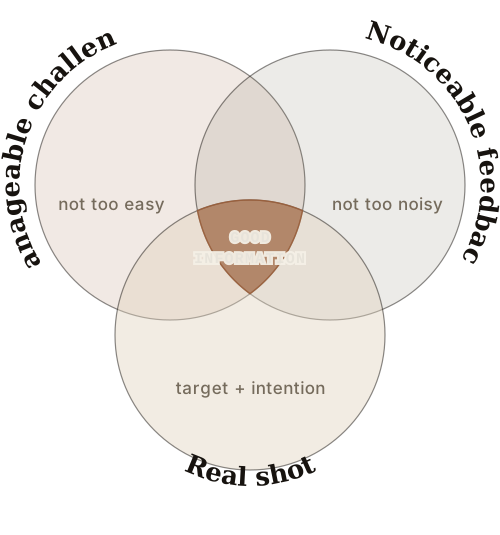
Four questions before the first boule
Before adding a constraint to your pétanque training, answer four questions:
- What part of the shot am I exploring?
- Why have I changed this condition?
- What could a miss tell me?
- How will I review what happened?
Do not add difficulty for its own sake. Say: “I want to see whether my landing picture still helps when I change the distance.” Then watch for that.
A six-boule pétanque training drill
Try this the next time a familiar pointing drill starts to feel comfortable.
- Start at seven metres with a familiar landing area.
- Choose one thing you want to keep. You might see the landing area, use the feeling from your slow-arm practice, or finish through the throw.
- Alternate between six metres, eight metres and ten metres for six boules in total.
- Keep that one thing in mind, but let the throw adapt to each distance.
- Do not score the six boules. After each one, notice what changed and what stayed with you.
- Finish with one normal, game-like boule and score that one if you wish.
- Write one useful sentence before the memory fades.
Your sentence might be: “I could still see the landing area at ten metres, but I rushed the finish.” That tells you more than “good set” or “bad set” and gives the next practice a starting point.
The first six boules are for noticing; the final boule checks what holds up in a normal shot.
If you find it difficult to notice one part of the throw, begin with The Witness Drill. It uses six slower boules and a short pause to help you observe before you try to change anything.
When the next boule looks worse
What you practised may still be available, but the changed shot can take more of your attention. If you are thinking about the extra distance, a different line and the result at the same time, the feeling you wanted to keep can get crowded out.
Variable practice can demand more attention and look worse in the moment, yet produce better retention later, according to motor-learning research. A poorer boule therefore does not prove that concentration was lost. It may be part of adapting to a new problem.
If the swing is what you are exploring, keep it whole: one smooth swing from start to finish. Do not turn it into a checklist while the boule is moving. Choose the feeling before the throw, let the movement adapt, then notice what happened afterwards.
If the feeling gets crowded out, make the change smaller and try again. If it disappears completely, return to the familiar shot for a few boules. You now know where the practice needs to go next.
How far can we take this?
Hua Li’s survey captured one moment in time. It found associations among athletes’ reports of task clarity, manageable challenge, feedback, psychological safety and engagement, but it cannot show cause and effect. It did not measure attention during a throw, learning or performance.
The Li and Wright study demonstrated a general motor-learning pattern in a controlled movement task. I am applying that lesson to pétanque with care: how your practice looks in the moment is not always the same as what you retain later.
The six-boule exercise is my practical application to pétanque: change one condition, keep one intention and judge what you learned over more than a single boule.
The next useful boule
Next time a drill feels settled, change one thing. If the shot unravels, notice what went first: the landing picture, the swing or the choice of throw.
In a notebook or the Pétanque Performance Journal, write what stayed and what disappeared. That is enough.
Keep the challenge. Make the miss useful.
Research
Li, H. (2026). The relationship between perception of the functional training environment and athletes’ training engagement: the mediating role of psychological safety. Frontiers in Psychology, 17, 1833341. https://doi.org/10.3389/fpsyg.2026.1833341
Li, Y., & Wright, D. L. (2000). An assessment of the attention demands during random- and blocked-practice schedules. The Quarterly Journal of Experimental Psychology Section A, 53(2), 591–606. https://doi.org/10.1080/713755890
Last time you changed one thing in a drill and it unravelled, what went first?
Discussion
Loading the discussion…
No answers yet. Yours can be the first.
Comments are temporarily unavailable.
Your comment will appear straight away. Spam or abusive comments may be removed.