
How to practise pétanque alone
Most of us throw alone far more often than we play. A coached session works partly because of the room: someone makes the moment matter, someone tells you what you actually did, someone expects an answer next week. On your own, none of that is there. This is how to get it back.
If you have the boules with you and want to throw now, start with The Late Release Drill, The Landing Spot, One Boule, One Chance or When Do You Stop Looking?.
Why doesn’t practising alone stick?
You can finish a practice session feeling like you have solved the shot.
Same distance, same line, same landing area. By the last few boules you know the weight, you have seen how the terrain reacts and the movement feels familiar.
That is useful. Repetition is often how we find something in the first place. The learning starts to deepen when we ask whether it still works when something changes.
A few days later, you have to rediscover it. In a match the distance may be different, the terrain may behave differently and another boule might be sitting where you wanted to land. You have to read what is in front of you, decide and throw without several previous attempts helping you.
What matters is whether some of what you found carries across. Can you recognise it at another distance? Can you adapt when the shot asks something different?
So use repetition to explore something, then ask a little more of it.
Change the distance. Change the line. Take the marker away. Give yourself one boule at a new problem. Notice what stays with you and what needs adjusting.
You are not making practice difficult for the sake of it. You are giving the learning somewhere else to go.
You don’t need to remember everything. Just keep hold of one thing that helped the throw come together. Video can also show you what the movement actually looked like.
That is what the rest of this guide builds: find something, understand it, then see whether it travels.
What is your mind doing while you throw?
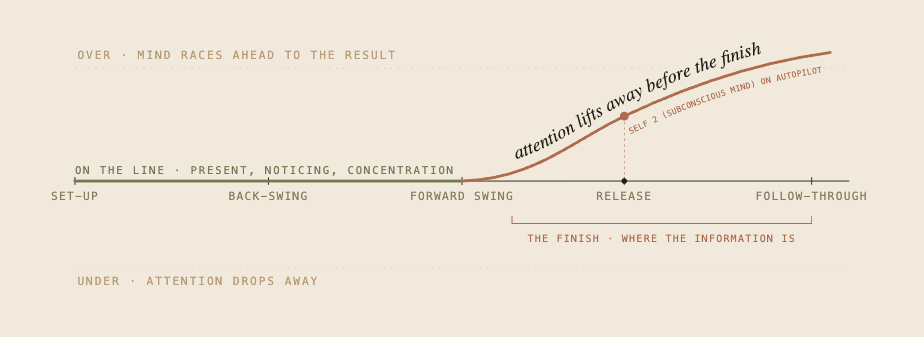
You often know when a throw was good. The difficult part is understanding what happened, why it worked, and what was different when it didn’t. That gap is usually your attention arriving at the result before the boule does. The mind is on the target while the arm is still finishing.
So the outcome is never the thing you’re missing. You always get that. What goes missing is everything that produced it.
Nothing out there compels your attention. In a match, the score, the opposition and the boule you have to get past all pull you towards the problem in front of you. Alone, nobody does that for you. You have to give your attention somewhere to go, and the session depends on how well you do it.
So stay with the one thing you set before you started, and notice whether the picture was clear before you let go. I slow down after a bad boule, because I have watched myself rush the next one. A miss can still give you useful information without following you into the next throw. Notice one thing, take the lesson, then let the rest go.
Why would you slow the arm down?
Because it gives you time to notice things.
On a normal throw, particularly when we know where we want the boule to go, our attention can race ahead. We see the line, start the movement and before the boule has even left our hand we’re already looking towards the landing spot or waiting for the result.
That means the release and the end of the movement can pass almost unnoticed.
Try throwing a boule at half your normal arm speed and pay attention to what happens through your hand, wrist and fingers as you release it. Don’t try to fix anything yet. Just notice what you feel.
That’s really what slowing the arm down is for.
It isn’t because slow is better. Your natural rhythm matters, and I don’t want you changing the way you normally throw. We’re simply slowing the movement down for a few boules so that something which normally happens very quickly becomes easier to feel.
Daniel Coyle describes super-slow practice as working like a magnifying glass: it helps us sense errors more clearly. I like that description because a magnifying glass is something you use to look more closely, then put down again.
That’s important here.
Once you’ve noticed something, go back towards your normal throw. Your body may organise the movement differently when the speed returns, so something that feels wonderful at half speed doesn’t automatically transfer.
My starting point would be six slow throws followed by six at your normal rhythm.
During the slow six, explore. During the normal six, don’t chase the feeling or try to manufacture the movement. See whether what you noticed is still there.
If it disappears, that’s useful information too. Go back, look again, and give it time.
You can also film the normal six. Slow practice lets you feel the movement by changing its speed; video lets you see the movement without changing it. Used together, they can tell you quite a lot.
And keep the question small.
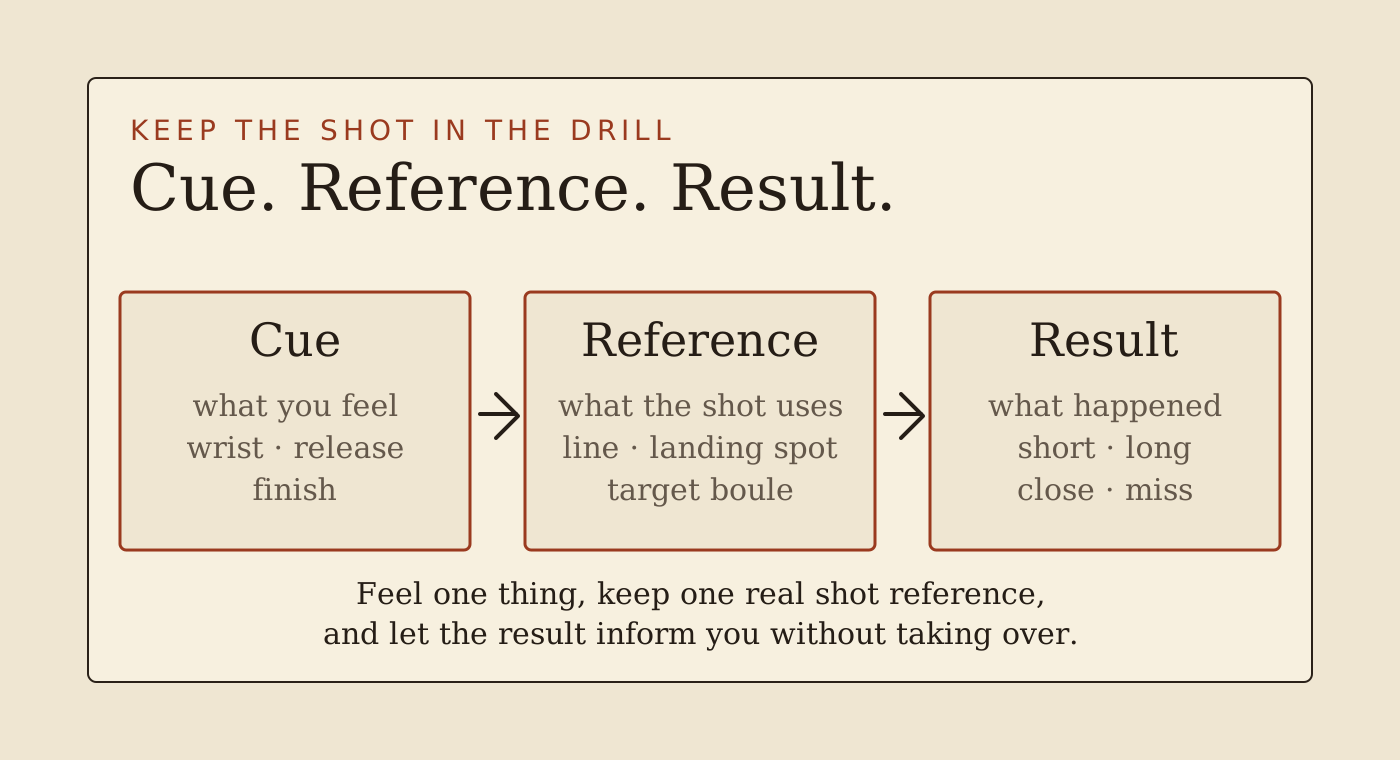
Don’t try to monitor your grip, wrist, arm, legs, balance, line and landing spot all at once. Pick one thing. Where did I feel the boule leave my fingers? Did my wrist stay relaxed? Did I finish the movement?
6 boules, 1 question, pay attention.
What makes it practice rather than throwing?
Not every session needs to change something. Sometimes keeping your eye in, throwing some boules and enjoying being on the terrain is reason enough.
But when you do want to work on something, it helps to give the session a little more structure.
Ericsson describes this as purposeful practice. In Peak, four things matter:
- A specific goal Know what you’re trying to improve.
- Full attention For as long as you can genuinely give it.
- Feedback Something that tells you what actually happened.
- A challenge Enough difficulty that you can’t just go through the motions.
What I like is how closely that overlaps with something Csíkszentmihályi found while studying flow.
He spent years studying people at the moments they felt most absorbed: climbers, surgeons, chess players, people working on a production line. The activities had almost nothing in common. Their descriptions did. The task had their whole attention, they could tell how it was going while they were doing it, and it asked enough of them to stay interesting without being beyond them.
That state is what he called flow.
You have probably felt some of it on the terrain, in an end where deciding to concentrate never came up because there was nothing else you wanted to look at.
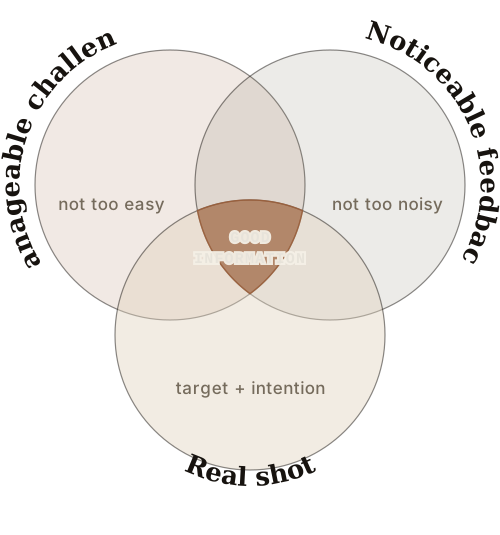
Three of the conditions he associates with it are clear goals, immediate feedback and a challenge matched to your ability.
Notice what’s missing from that list: try harder to concentrate.
You can arrange the other three before you throw. Give yourself a clear job, make the result easy to see and set the challenge at the right level. Do that well enough and you’ve given your attention somewhere useful to go.
So start with something you noticed in your last match.
Maybe four of your first six boules finished short at a distance you would normally expect to be comfortable with. Don’t turn that into I need to get better at distance. That’s too big to practise.
Make the question smaller.
Can I land the boule where I intend to?
Mark the landing area if you need to. Now each throw gives you an answer. Where did it land? What happened after it landed? Where did it finish?
That’s your feedback. The terrain gives it to you every time you throw.
What I would write down is what you noticed.
Do it before you leave if you can. An hour later, six very different boules have a habit of becoming I pointed quite well today or that wasn’t a great session. The useful detail disappears.
Goal, feedback, challenge.
You don’t need to make the session clever. Know what you’re looking at, make the answer visible and give yourself enough attempts to learn something from it.
Then come back and see what is still there.
How do you build a drill that teaches you something?
A good drill gives every boule a job and gives you a clear idea of what you’re looking for.
Start with a question. Keep it small enough that one throw can give you some kind of answer.
Then build the setup around it.
If you want to know whether you can still produce a high lob, put something in the way and make yourself go over it. If you’re exploring your release, keep the distance and shot the same for a while so you get several chances to notice what your hand is doing.
You aren’t trying to make the drill difficult for the sake of it. You’re arranging the terrain so that what you’re interested in becomes easier to see or feel.
Then throw and notice what comes back.
Not whether it was good or bad.
Where did it land? What did it do after it landed? What did the throw feel like? Was that what you expected?
There’s a useful little exercise here.
Before you walk towards the boule, decide where you think it landed. Then go and look.
You might think you landed twenty centimetres short when it was actually sixty. You might be convinced the boule came cleanly from your fingers and then notice on video that something quite different happened.
That gap matters.
It’s the difference between what you thought you produced and what you actually produced. As that gap gets smaller, you’re getting better at understanding your own throw.
Keep the drill connected to pétanque.
Use a distance that catches you out. Put a boule in the line that you either need to avoid or land over and still win the point. Give yourself a landing area that leaves the boule short and in front rather than disappearing behind the jack.
Make the setup as clear as it needs to be to help you notice the thing you’re working on. Then bring it back to a shot you might actually play in a match.
And once you’ve chosen the question, stay with it for a while.
If one boule goes wide while you’re exploring your release, notice it, but don’t immediately start fixing your line. Otherwise every throw gives you a new problem and ten minutes later you’ve forgotten what you came out to practise.
Create the situation, throw with purpose, notice what happened and compare it with what you intended. That is what turns a drill into practice.
When should you make it harder, and how?
When the drill stops telling you anything new.
If the next set is only going to tell you what the last one already did, it may be time to change something.
Change one thing.
Move the distance. Tighten the landing area. Change the terrain.
Do it one at a time because each change asks you a slightly different question. Change several things together and it becomes much harder to know what the throw is actually telling you.
Nine metres isn’t simply seven metres made harder. The extra distance may change how you organise the throw.
If you’re working on your release, you’re now asking whether the same feeling and control are still there when more distance is required. Tighten the landing area instead and you’re asking more about precision and weight.
Same drill, different question.
There is another way to make a drill harder, and it is one people often forget.
Take away some of the help.
If a marker has been showing you where to land, remove it and see whether you can still find the same area without it. If you can’t, that tells you the marker was doing more of the work than you realised.
That is useful information.
Then take the drill towards the places a match might take you.
Move to a distance you avoid. Change the terrain. Put a boule in the line you need to get around or over. In a match you won’t always get the distance, line or terrain you would choose for yourself, so practice should gradually give you experience in those places too.
But harder is not automatically better.
If the drill becomes so difficult that you can no longer connect what you felt with what happened, you have probably gone too far.
Make it simpler again.
A shot you are still discovering needs enough space for you to notice it. Adding difficulty before you can read the feedback just creates more noise.
The aim was never to make practice hard. It is to keep it asking you something, while you can still read the answer.

How would you know it is working?
Before you start, know what you’re looking for and how you’ll recognise it.
If you’re exploring your release, notice what you felt straight after each boule, while the feeling is still fresh. Leave it until the end of the set and six different throws can quickly become one vague memory.
Film it if you can.
What you remember feeling and what the throw actually looked like are not always the same thing. Comparing the two can help you understand your own throw more clearly.
Then be careful what you make of it.
The boule tells you what happened. It doesn’t always tell you why. One short boule is information, not an explanation.
Draw a conclusion too quickly and you can end up trying to fix something that was never the problem.
Over time, four questions become useful.
- Did it improve? Could you produce what you were working on more reliably as the session went on?
- Did it stay? When you came back next time, was some of it still there before you had to find it again?
- Did it travel? Could you still find it at another distance, on different terrain or when the shot changed?
- Did it show up? When you needed it in a game, was it there without you having to search for it?
A lot of things can feel better during one practice. Fewer are still there when you come back. Fewer again survive when the distance, terrain or situation changes.
Improvement in one session is encouraging. Learning is what stays, travels and shows up when you need it.
Write down what you noticed, then look for the pattern over time rather than judging the session from one good day.
How many boules, and how long between them?
There isn’t a magic number, and there isn’t a perfect gap between throws.
I often work in sets of six because it gives me enough throws to start noticing a pattern without disappearing into repetition. But that’s just me. We all hold attention differently, so experiment and find what works for you.
When I use slow practice, I follow six slow throws with six at normal speed. The slow set gives you time to notice. The normal set brings your rhythm back and lets you see whether what you noticed is still there in your usual throw.
The time between boules is personal too.
Give yourself long enough to read the throw you just made.
Where did it land?
What did you feel?
Was it what you intended?
If you have understood what the last throw gave you and you’re ready for the next one, go again. If the throws start to blur together or you lose the question you were working on, give yourself longer.
When you stop learning from the last boule and start throwing just to finish the set, stop.
Where the research becomes more useful is between sessions. Spreading practice over different days generally gives learning a better chance to stay than squeezing the same work into one long session.
How often should you practise?
More often, in smaller pieces.
The research supports spreading practice, but it doesn’t give us a perfect schedule. That is good news. You don’t need to find the ideal number of days between sessions.
If you have an hour a week, I would rather see you find two or three shorter opportunities to practise than try to squeeze everything into one long session.
The important part is that you keep coming back.
At the end of a session everything is still familiar. You have just thrown the shot, felt the release and made the adjustments. Come back another day and some of that has gone quiet. Now you have to find it again.
That matters.
What you can do at the end of practice tells you how you performed that day. What is still available when you come back tells you more about what you are actually learning.
Don’t panic if the first few boules feel rusty either. A break can make a familiar movement feel less immediately available. Give yourself a few throws and notice what comes back.
Spacing practice doesn’t mean leaving huge gaps. Find a rhythm you can return to consistently and that fits around the rest of your life.
The space between sessions matters too. Writing down what you noticed, what stayed and what you want to return to gives you a clearer idea of what the next session is for. That is one of the reasons I use the journal.
Ten or fifteen useful minutes still counts. You don’t need to save everything for the day when you have an hour.
The best schedule is one you can keep returning to with enough attention to make the time useful.
Where should your eyes be before you throw?
Settled, but only after you have finished looking.
You look because the shot is asking questions.
What is the terrain doing? Where can I land? What do I need to avoid? What happens if I catch that boule? Is this still the shot I want to play?
Sometimes the choice is obvious. Other times, the terrain, another boule or the score gives you more to think about.
Once those questions are answered, there should be less left for your eyes to search for.
For a point, they might settle on the landing area you have chosen. For a shot, on the boule or part of the boule you intend to hit.
Researchers call that final steady look the quiet eye. Skilled performers have repeatedly been shown to hold it longer, and the better attempts tend to come with a longer final gaze. It may also tell us something about where your attention is settled before the throw.
My own way of thinking about it goes a little further than the research. I don’t think settled eyes are necessarily something we should try to create. They may simply be what happens when we have answered enough of the questions in front of us. A settled mind has no questions left to answer, so attention is easier to direct.
If your eyes keep moving between the jack, the landing spot, a boule in the way and the terrain around it, don’t immediately tell yourself to concentrate harder.
Something may still be unresolved.
Maybe you haven’t committed to the landing spot. Maybe you are still deciding how to get around the boule in front. Maybe part of you is still thinking about what happened with the last boule.
Not everything in the picture is on the terrain. The last throw can still be there. So can the score, doubt, or the thing you are trying not to do.
Take what is useful from that information, make the decision, then give this boule the space to be its own shot.
This is where your routine earns its place. Not as a ritual for producing a quiet eye, but as a familiar way through the questions. Read the end. Choose the shot. See what you are asking the boule to do. Then let your eyes settle somewhere useful and stop adding to the picture.
Don’t stare your way into clarity. Find clarity first, then let the eyes settle.
What should you write down after practice?
A few boules worth remembering, and not necessarily the ones that finished closest.
For each one, keep enough to rebuild the picture. The donnée you read, the shot you chose, the landing spot you committed to, what happened and what you noticed.
Then keep one word for how the throw felt.
Quiet. Soft. Clean. Full. Slow.
The word matters because it means something to you.
If one particular throw felt slow, you now have an experience attached to that word. The next time a shot asks for that same quality, slow can give you a way back towards what you felt without having to think through your arm, wrist, fingers and release one piece at a time.
Researchers sometimes call these holistic cues. Words such as smooth or soft have been used to capture the overall feeling of a movement rather than one technical part of it.
I think of the word as a small bridge between the feeling and the action.
It isn’t storing the throw, and it isn’t an instruction to copy it. Slow doesn’t mean deliberately make the next throw slow. It reminds you of a quality you experienced when the movement worked the way you wanted it to.
That is why the word has to be yours. Another player can tell you to be smooth, but that word is much more useful when you already know what smooth feels like in your own throw.
If you filmed the boule, keep the clip that went with it. Now the word, what you felt and what the movement actually looked like have somewhere to meet.
Then write down one thing you learned from something that didn’t work, and one thing worth returning to next time.
That’s enough.
Don’t turn reflection into a repair list. You don’t need to record every miss or explain every mistake. Keep what taught you something, notice what starts to repeat, and give the next session somewhere useful to begin.
That is what the journal is for. Not to record every boule, but to help carry the useful parts of one session into the next.
Which drills can you do on your own?
Three to start with, and each asks something different of you. Pick the one that matches what you want to learn rather than trying to fit all three into one session.
Whatever drill you choose, keep the same rule.
What happened?
What did you feel?
What is useful for the next one?
Take the information. Leave the verdict.
- The Late Release Drill Slow the movement enough to notice where the boule leaves your hand, then return to your normal rhythm and see what remains. For: release, feel and awareness. The question: Where did I feel the boule leave my hand?
- The Landing Spot Choose the donnée before you throw, then compare where you thought the boule landed with where it actually did. For: reading the terrain, weight and understanding your own throw. The question: Did it land where I thought it landed?
- One Boule, One Chance Give yourself a series of different shots with one attempt at each. Read it, choose, commit, throw, then move on. For: decision making, routine and finding the shot when the picture changes. The question: Can I find this shot without using another boule to correct the first?
- When Do You Stop Looking? Build the picture in four set situations, from an open line to a crowded one, and find out what your eyes are still working on when you throw. For: attention, and knowing when the decision is actually made. The question: Is the picture finished, or am I still looking?
Some of this is what I’ve learned on the terrain, and some of it is what the research points at. I try not to pretend they are the same thing.
There is very little research on how an experienced pétanque player should practise alone. Most of what we can borrow comes from other self-paced aiming skills, motor-learning research and a small number of studies involving pétanque itself. A golf putt or a dart can tell us something useful. It still isn’t a boule on uneven terrain.
Where the evidence is strong enough to guide the advice above, I’ve used it. Where it only gives us a direction, I’ve said so. And where something is simply how I practise, that belongs to me rather than to a paper.
The full evidence review sets out every paper, what I think it supports, and just as importantly what it doesn’t.
Want a structured six-week cycle? The journal runs one, in this order:
The six weeks, five habits and pages that hold this work between sessions are in the printed Pétanque Performance Journal. I built it because I wanted what I noticed in one session to still be useful when I came back for the next.
See what is inside the book →Running it with a club rather than alone? The session guide →
Practise, leave it, then come back and find it again.